


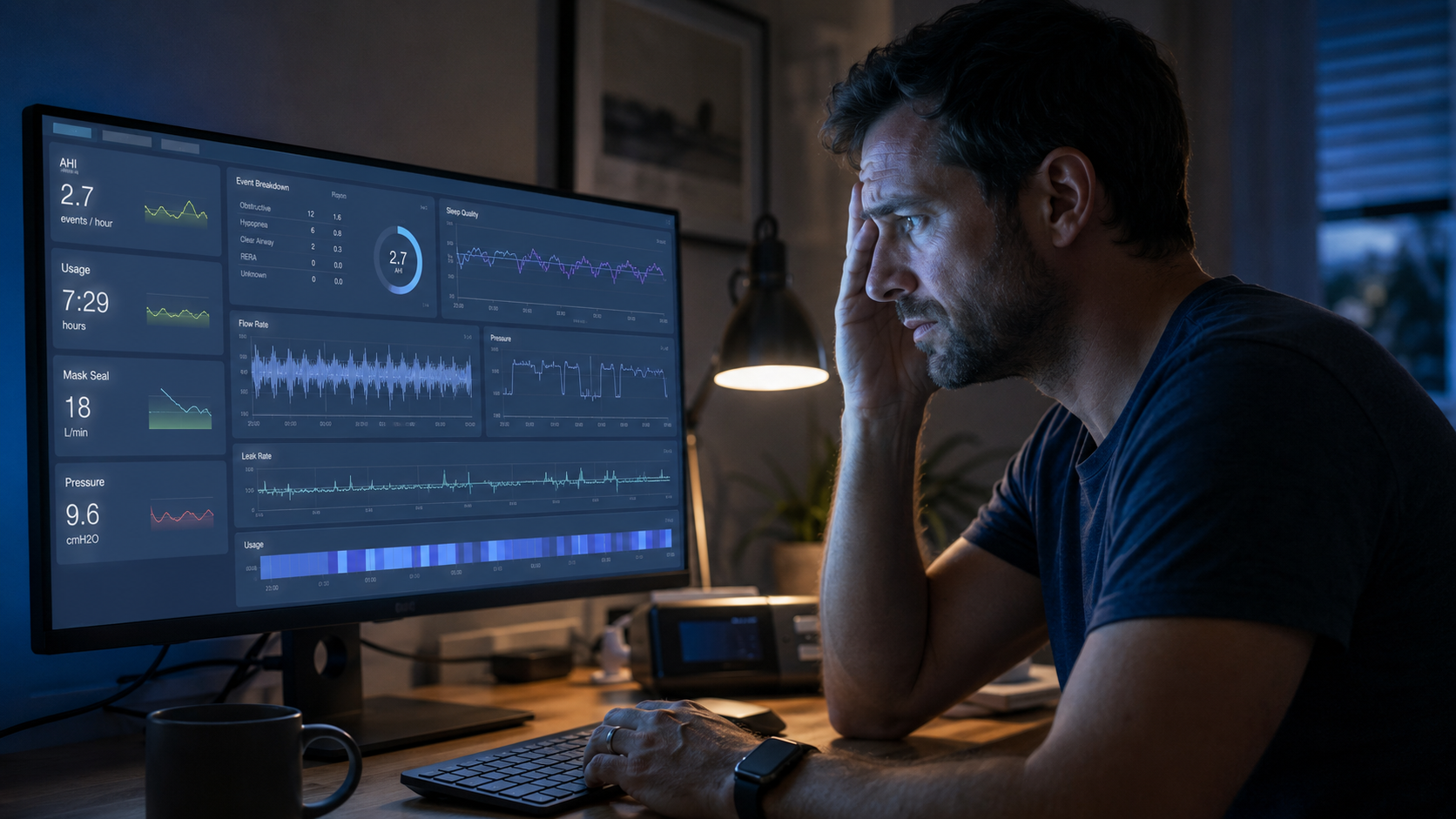
Compliant, Low AHI, and Still Exhausted
It's one of the most frustrating situations in CPAP therapy: you wear the mask every night, your app says your AHI is under 5, your provider tells you the numbers look great — and you still wake up unrefreshed, foggy, and tired.
You're not imagining it, and you're not doing anything wrong. The problem is usually that the summary number everyone is looking at doesn't capture what's actually disrupting your sleep.
Why a Low AHI Can Mislead You
AHI only counts events that meet strict scoring rules — full apneas and clear hypopneas. But sleep can be badly fragmented by things that never reach that threshold:
- RERAs (respiratory effort-related arousals) — your airway narrows enough to briefly wake your brain, but not enough to score as an event.
- Flow limitation — sustained partial airway narrowing that the machine tolerates without flagging anything.
Research has shown these subtle arousals can cause the same daytime symptoms as scored apneas. So an AHI of 3 can sit on top of a night full of micro-arousals your number never counted.
A Checklist for the Still-Tired CPAP User
When the AHI looks fine but you feel awful, work through the data your machine actually recorded:
- Flow limitation: are there long stretches of flattened breaths? This is the most common hidden culprit.
- Leak: high mask leak fragments sleep and undermines pressure even when your AHI stays low.
- Pressure behavior: on an auto machine, is pressure sitting at the minimum all night while flow limitation is present? That can mean the algorithm is undertreating you.
- Session fragmentation: lots of short broken sessions can leave you unrefreshed even with good total hours.
- Event type: a low AHI made mostly of central apneas points somewhere very different than obstructive events.
- Comfort factors: ramp, humidity, and mask fit all affect sleep quality without showing up in AHI.
The UARS Possibility
If your data shows persistent flow limitation, pressure hovering at the low end, and a low event count — while you feel exhausted — that pattern is the signature of UARS (Upper Airway Resistance Syndrome). UARS is common, frequently undiagnosed, and specifically the kind of problem AHI is blind to.
It's not a diagnosis you make from an app, but it's absolutely something you can spot the footprints of in your own data and then raise with your doctor.
What to Do Next
Being "still tired on CPAP" with good numbers is a reason to look closer, not to give up. Import your SD card into CPAP Insights and look past the AHI at your flow limitation, leaks, pressure behavior, and event breakdown. If you see the patterns above, that's concrete evidence to bring to your sleep physician — the kind that can actually change your therapy.
The data that explains why you're tired is almost certainly already sitting on your card.