


What Is a Hypopnea?
An apnea is a near-complete stop in airflow. A hypopnea is a partial reduction: breathing becomes shallow enough to matter, but air never stops entirely. Both count toward your AHI (Apnea-Hypopnea Index), which is simply the total number of events divided by hours of therapy.
In a sleep lab, the AASM scoring manual describes a hypopnea as a drop in airflow of at least 30% lasting 10 seconds or longer, paired with either an oxygen desaturation (3% or 4%, depending on the scoring rule used) or an arousal from sleep. The key point is that a lab can see the *consequence* of the event, such as a dip in oxygen or a brain-wave arousal.
A home CPAP machine has no EEG and, in most cases, no oxygen sensor. It sees only airflow and pressure. That gap explains why the hypopnea count on your machine and the count on a diagnostic sleep study can differ, even when both are reasonably accurate for what they measure.
How CPAP Machines Detect Hypopneas
CPAP and APAP devices continuously measure airflow through the mask and compare each breath with a recent baseline. When flow falls below a threshold for roughly 10 seconds or more, the machine logs an event.
A few practical points follow from this:
- Flow only. The device cannot confirm that you woke briefly or that your oxygen fell. It labels an event based purely on the shape and size of the airflow signal.
- Thresholds vary by manufacturer. ResMed, Philips, and Luna each use their own proprietary algorithms. A hypopnea on one brand is not guaranteed to match the definition on another, so comparing raw numbers across devices is unreliable.
- Hypopneas are usually not classified further. Machines generally cannot say whether a hypopnea is obstructive or central in origin.
- Leak interferes. Large or fluctuating mask leak distorts the flow signal, which can hide real events or occasionally create false ones.
The result is a useful trend indicator rather than a diagnostic measurement. Day-to-day changes in your hypopnea count tell you more than any single night's absolute value.
Why Hypopneas Matter for Your AHI
For many people on therapy, hypopneas account for a large share of residual events, sometimes more than apneas. That makes the *breakdown* of your AHI worth checking, not just the headline number.
A few reasons the split matters:
- Hypopneas often reflect partial airway narrowing. This overlaps with the flattened breath patterns described in flow limitation analysis, where airflow is restricted but not blocked.
- They can fragment sleep without being dramatic. A person can have a modest AHI and still experience frequent micro-arousals if breathing effort is rising from breath to breath.
- They respond differently to pressure. In general terms, residual obstructive events can sometimes shift with pressure changes, while other patterns, such as leak-related distortions, will not. Any such adjustment is a decision for your clinician.
If your AHI sits in a comfortable range but you still feel unrefreshed, comparing hypopnea counts with flow limitation scores is a sensible next step. UARS-type breathing, which may produce few formal events, can hide in exactly this space. CPAP Insights includes UARS screening and flow limitation analysis for that reason.
Patterns to Look for in Your Data
Once your SD card data is imported, a few patterns can help you interpret hypopnea counts rather than just reading them.
- Time of night. Clusters in the last third of the night often coincide with REM sleep, when muscle tone drops and the airway becomes more collapsible. Our post on AHI timing covers this in more detail.
- Leak correlation. If hypopnea flags rise alongside spikes in unintentional leak, the flow signal may be unreliable at those moments. Fix the seal question first, then reassess.
- Pressure at the time of events. On an APAP, check whether events occur while pressure is climbing, flat at the top of the range, or stuck near the minimum.
- Ratio to apneas. A shift in the hypopnea-to-apnea ratio over weeks may be more informative than the total.
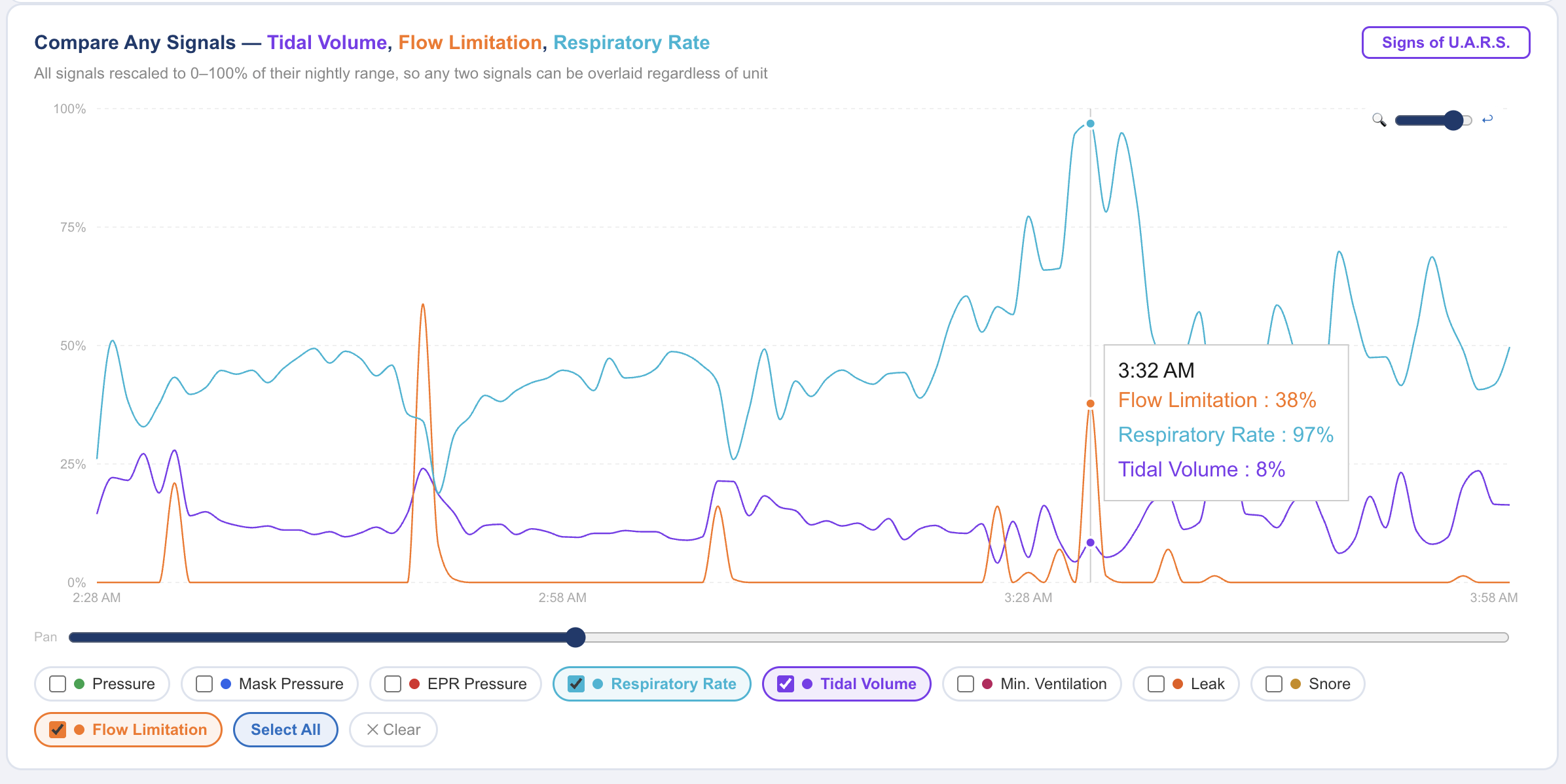
Using Build a Graph, you can overlay hypopnea events, pressure, leak, and flow limitation on one timeline. Seeing them together usually reveals whether events cluster around a specific cause, such as sleeping on your back or a mask leaking during a position change.
Common Misreads and Next Steps
Several assumptions about hypopneas lead people astray.
- "Lower is always better." An AHI near zero is encouraging, but it says little about breathing that falls just short of the machine's detection threshold.
- "The machine's hypopnea count equals my lab study." The two methods measure different things, so some mismatch is expected.
- "One bad night means a problem." Alcohol, congestion, a new mask, or sleep position can all push a single night off trend. Look at a week or more.
- "I can fix this with pressure changes myself." Pressure, EPR, and range adjustments interact with leak, comfort, and central event risk, so they belong in a conversation with a clinician.
A practical approach: track hypopneas, leak, and flow limitation over two to four weeks, note the patterns, and bring the charts to your appointment. Sleep Doc AI can help summarize what the data shows and suggest questions to ask.
This article is educational and not medical advice. Discuss persistent symptoms or any therapy setting changes with your sleep doctor.