


Why UARS Hides From Your AHI
UARS — Upper Airway Resistance Syndrome — is a form of sleep-disordered breathing where your airway narrows enough to fragment your sleep, but not enough to trigger the apneas and hypopneas that make up your AHI. The result is a person who is genuinely, measurably sleep-deprived while every summary number says they're fine.
Because AHI is the number most tools and providers focus on, UARS routinely slips through. But its footprints are all over the detailed data your machine records — if you know where to look.
Reading the Flow Waveform
The most valuable signal for UARS is the flow rate waveform — the breath-by-breath record of airflow. A normal breath has a rounded top on the inhale. When the airway is partially narrowing, that top flattens out, like the peak got clipped.
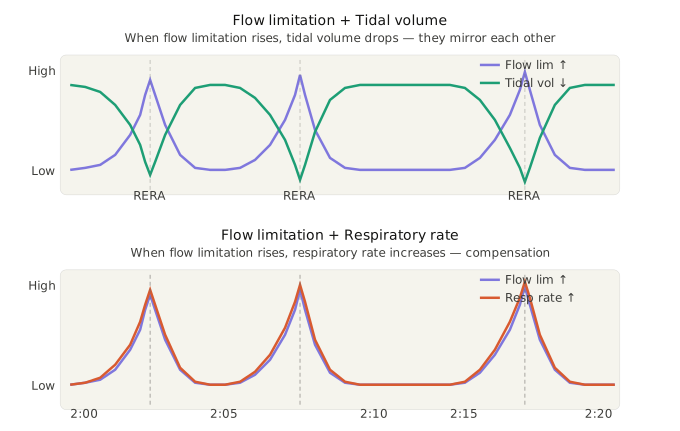
That flattening is flow limitation, and it's the core signature of upper airway resistance — present even when the machine scores no event at all. Long runs of flattened breaths, especially followed by a sudden big recovery breath, are exactly what you're hunting for.
The Patterns That Point to UARS
No single number diagnoses UARS, but a cluster of findings builds the case:
- Sustained flow-limitation clusters — stretches where flow limitation stays elevated for minutes at a time, rather than brief blips.
- A low AHI alongside those clusters — the tell-tale mismatch: subtle obstruction without scored events.
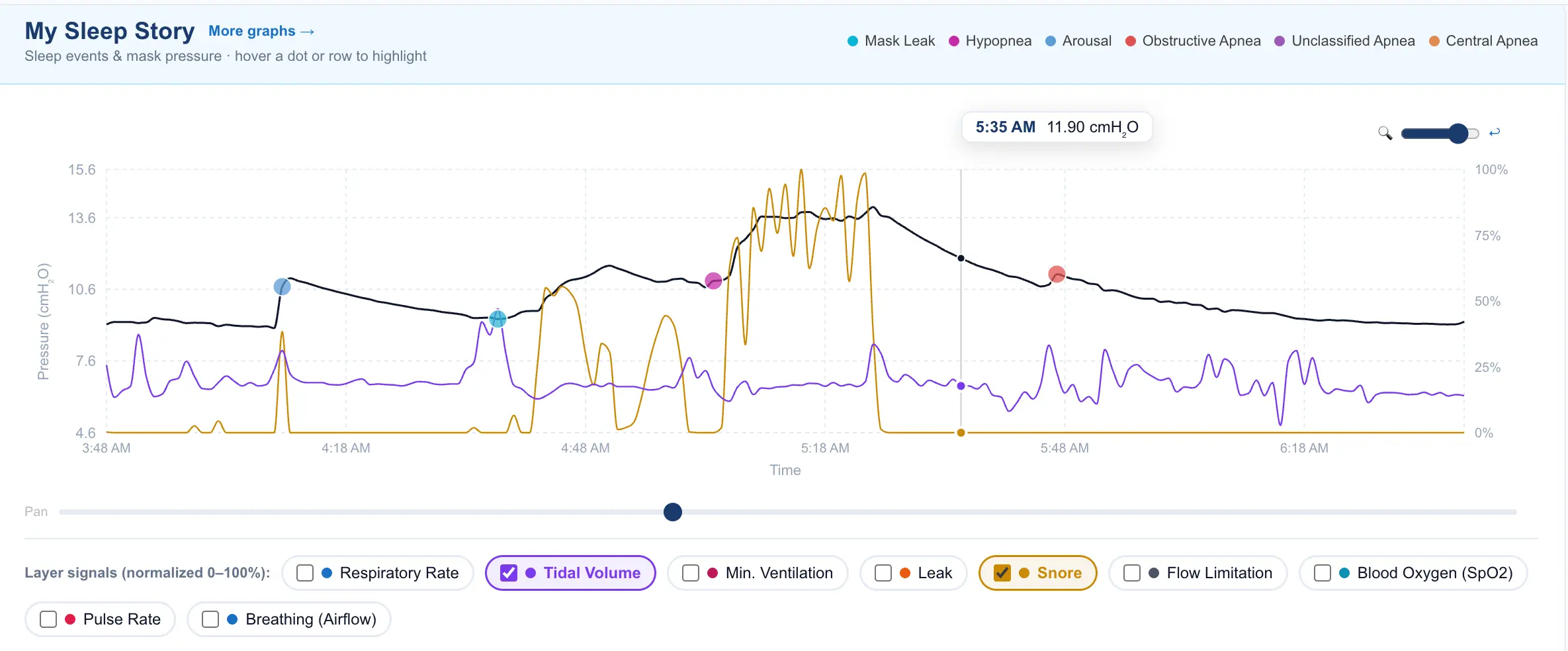
- Pressure sitting near its minimum — if an auto machine holds low pressure while flow limitation is clearly present, the algorithm may be undertreating the resistance.
- RERAs and recovery breaths — clusters of flow-limited breaths ending in a large recovery breath strongly suggest an arousal, even if the machine didn't score a RERA.
One Limitation to Keep in Mind
SD card data can't record brain waves, so arousals themselves aren't directly visible — they're inferred from the breathing pattern. That means your data can strongly suggest UARS, but it can't formally diagnose it; only a clinician, sometimes with a repeat study, can do that.
What your data can do is turn "I just feel tired" into "here are hours of sustained flow limitation with pressure stuck at minimum" — which is a far more actionable conversation to bring to your doctor.
Spotting It in CPAP Insights
CPAP Insights was built partly around this exact problem. When you import your card, it surfaces flow limitation patterns and screens for the UARS signature — sustained flow-limitation clusters, how much of the night pressure sat near its minimum, and how those line up with your events — then explains what it's seeing in plain language.
If you've read our overview of what UARS is and suspect it applies to you, this is the next step: load your own data and see whether the pattern is actually there. For many people who were told their numbers looked fine, it is.