


Why Your AHI Is Split Into Event Types
Most CPAP summaries show a single AHI, but the number is built from several event types. ResMed and Philips machines typically report obstructive apneas (OA), clear airway apneas (CA), hypopneas (H), and sometimes unclassified apneas.
The difference matters because the events have different causes:
- Obstructive apnea: The airway collapses or is blocked while the body keeps trying to breathe. Raising pressure is the usual mechanical fix.
- Central (clear airway) apnea: The airway is open, but breathing effort pauses. Pressure is not the main lever here, because the airway was never the problem.
- Hypopnea: A partial reduction in airflow. Machines do not reliably label these as central or obstructive.
If your AHI is 4.0 and nearly all of it is obstructive, the story is very different from an AHI of 4.0 that is mostly clear airway events. The total looks identical, but the follow-up questions diverge. That is one reason the AHI alone [never tells the full story](/blog/good-ahi-on-cpap-what-the-number-means), and why checking the breakdown is a worthwhile habit.
How a CPAP Machine Decides an Apnea Is "Clear Airway"
During an apnea, many ResMed devices send a tiny pressure oscillation into the airway and measure how the airflow responds. This approach is often described as the forced oscillation technique. If the airway is open, the signal passes through and produces a measurable response, so the event is flagged as a clear airway apnea. If the airway is closed, the response is blunted, so it is classed as obstructive. Philips devices also report clear airway events using their own proprietary detection methods.
This is clever, but it has limits:
- Home devices are not sleep labs. A lab study uses chest and abdominal effort belts or esophageal pressure to directly measure breathing effort. Your CPAP infers it from airflow.
- Leaks and mouth breathing can degrade accuracy. Large or erratic leak can confuse the algorithm.
- Brands differ. Detection methods and thresholds are not identical, so comparing raw CA counts between a ResMed and a Philips machine is unreliable.
Treat the CA count as a useful signal worth looking at, not a diagnosis. Only a clinician reviewing your full history, and sometimes a formal sleep study, can establish what type of apnea is actually occurring.
When a Few Clear Airway Events Are Normal
Seeing some clear airway events is common and often unremarkable. Brief central pauses can occur around sleep onset, during transitions between sleep stages, and after arousals or sighs, even in people without sleep apnea. The respiratory control system briefly overshoots and corrects.
Some general patterns tend to be less concerning:
- A low CA index (well under 1 event per hour) alongside a low overall AHI
- Events clustered near the start of the night or right after you shift position or wake briefly
- Short, isolated pauses without a run of repeated events
CPAP also changes how you breathe, and the first weeks of therapy can include some adjustment as your body adapts to pressure support. Consistency across several weeks matters far more than any single night.
The pattern is what deserves attention: a CA index that is climbing, persistent for weeks, or making up a large share of your total AHI is worth flagging to a clinician rather than waiting out.
Treatment-Emergent Central Apneas: The Pattern to Know
Some people with mostly obstructive sleep apnea develop a noticeable rise in central events after starting PAP therapy. The American Academy of Sleep Medicine's classification system (ICSD-3) recognizes this as treatment-emergent central sleep apnea, previously often called complex sleep apnea. In many cases it eases over time as breathing stabilizes with consistent use, but it does not resolve for everyone.
What the pattern can look like in your data:
- Obstructive events drop sharply, but CA events rise and account for a large share of the AHI
- Central events appear in repeating clusters rather than as isolated blips
- Periods of periodic or waxing-and-waning breathing show up in the flow signal
- Symptoms like fragmented sleep or fatigue persist despite a low-looking obstructive count
There is no safe do-it-yourself fix here. Changing pressure, EPR, or other settings in response to central events can help or backfire depending on the individual, and some cases need a different device type entirely. That decision belongs with your sleep physician, ideally with your data in hand.
How to Investigate Clear Airway Events in Your Data
A systematic look beats staring at a nightly total. Using your SD card data in CPAP Insights, try this routine:
- Check the trend, not one night. Compare the CA index across at least two to four weeks to see if it is stable, falling, or rising.
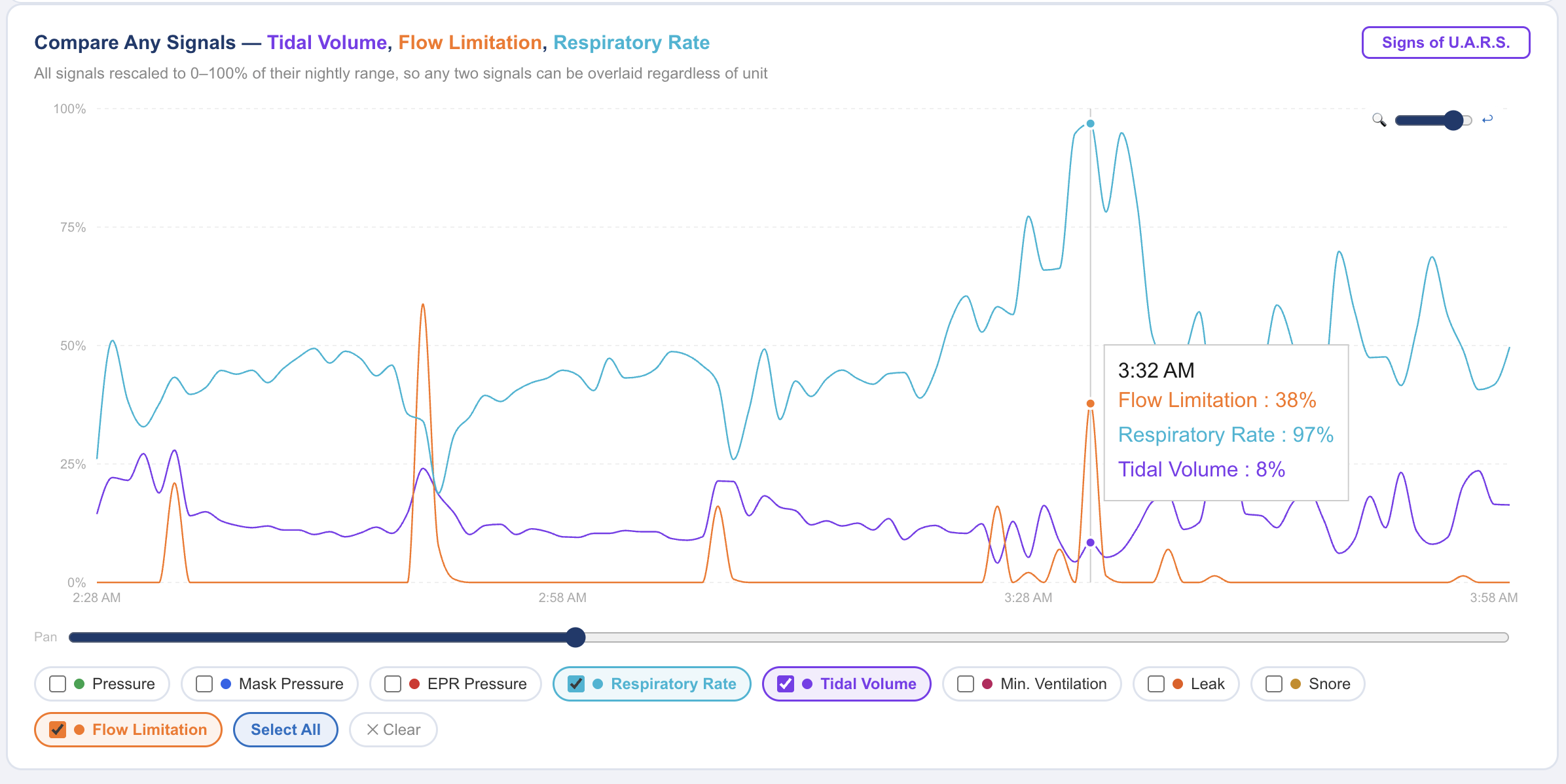
- Look at timing. Use Build a Graph to overlay events, pressure, and leak on one timeline. Do clear airway events bunch up at sleep onset, after leaks, or in certain hours?
- Check leak first. If large leaks coincide with CA flags, the classification itself may be unreliable.
- Review the flow waveform. Repeating cycles of growing and shrinking breaths look different from isolated pauses. The [flow limitation analysis](/blog/flow-limitation-cpap-flattened-breaths-explained) can also help separate narrowing-airway patterns from open-airway ones.
- Note context. Sleep position, alcohol, sedating medications, and opioid use can all influence breathing patterns, and your doctor will want to know about them.
The Sleep Doc AI feature can help summarize patterns and suggest questions to bring to an appointment. It is a way to organize your data, not a substitute for a clinician.
If clear airway events are a large share of your AHI or keep rising, bring a few weeks of exported data to your sleep doctor and discuss whether further evaluation or a therapy adjustment makes sense.